

How do you create a high-quality healthcare workplace experience?
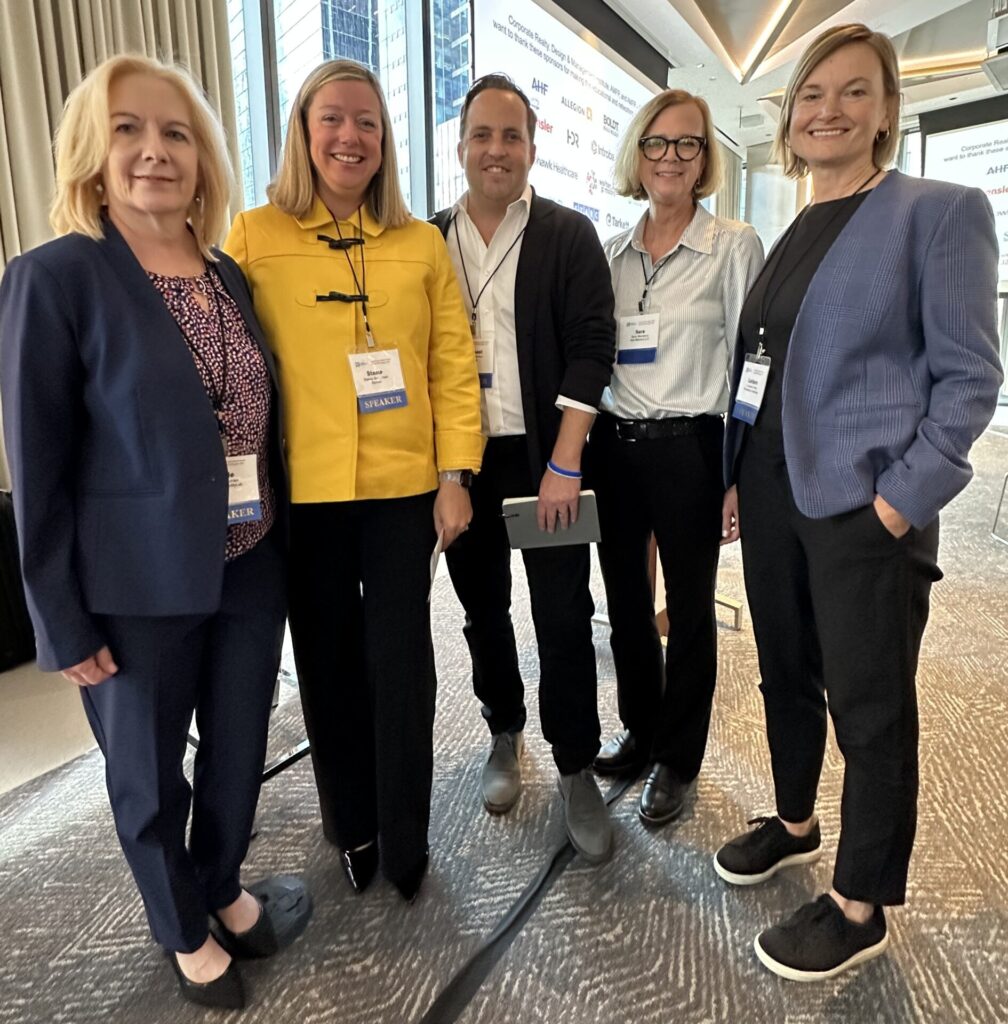
That was the topic of a 35-minute panel discussion I moderated at the Hospital, Outpatient Facilities & Medical Office Buildings Summit last week in Chicago. My all-star panel (L-R in photo) included:
- Margie Gauthier, Operations Director, Shirley Ryan Ability Lab
- Stasia Suleiman, Regional Healthcare Practice Area Leader, Interior Design Director, Gensler
- Michael Shur, Global Wellness Leader, Gensler
- Me
- Loriann Duffy, Executive Director, Operational Excellence/RESO, Providence
Gensler’s research
Michael and Stasia started off the discussion by sharing some of Gensler’s research to frame our thinking. Key findings:
- Only 38% of the global workforce love their workplace experience.
- A great workplace experience positively impacts behaviors.
- Amenities are not optional. They are an important part of the experience within the workplace as well as beyond the workplace in the neighborhood.
- A great experience impacts attitudes, such as employee engagement, happiness, motivation, and meaning.
They also called for redefining the healthcare workplace so it is high performing, highly adaptable, and highly flexible, asking these questions:
- What if the employee’s well-being and health became central to workplace design strategies?
- What if the workplace prioritized creativity over efficiency?
- What if the workplace were hyper-efficient, restorative, and regenerative?
- What if the workplace fostered continuous learning?
What contributes to stress?
When asked about what issues contribute to stress in the healthcare workplace, some of the issues Margie and Loriann identified were high caseloads, staffing shortages, IT issues, crowded spaces, and noise. They did not see onsite amenities such as fitness centers or multiple dining options as important because of the cost.
However, they did like the idea of having easy access to these types of amenities in the community, and agreed that respite areas (outdoor spaces, break rooms) are important for staff. Location of these areas is critical, though, because if they are too far away from their patients, they won’t be used.
So maybe its less about providing amenities and instead designing healthcare workplaces that can help staff tap into their sense of meaning and purpose and make them feel valued and cared for. Ones that promote or offer beauty, joy, caring, fun, privacy, camaraderie, safety, and efficiency.
Tapping into meaning and purpose
According to Margie, promoting camaraderie was one of the reasons the Shirley Ryan Ability Lab was designed with open spaces. This allows staff and researchers to randomly run into each other, get to know each another, and share information and ideas. “It worked,” she said. “And it has driven innovation.”
We also spoke about how technology can contribute the healthcare workplace experience. Loriann shared that Providence is using AI to analyze voice mail and do auto translation at the bedside. Margie said they are using it to order supplies and locate shared equipment.
These are things that help clinicians do their jobs better and likely contribute to their satisfaction, but what about design interventions that utilize technology to enhance the healthcare workplace? Things like circadian lighting systems, sound masking with acoustical sensors, thermal/air quality micro-zones, touchless doors/fixtures, etc. We didn’t really get into that in this discussion.
In the end, a high-quality healthcare workplace isn’t a list of perks or life-enhancing technology—it’s a system that removes friction, restores energy, and reconnects people to purpose.
See the original article as well as more insights on Sara Marberry’s Blog. This article originally ran on September 19, 2025. Marberry is a healthcare design expert with over 25 years of experience in the healthcare and senior living design industry, who has written/edited five books and is a regular contributor to Healthcare Design magazine. Marberry also is a former Executive Vice President of the nonprofit Center for Health Design.
See also on Sara Marberry’s Blog: